Walk into any theatre during a technical rehearsal and you'll find the lighting designer hunched over a desk in the stalls, calling cue after cue into a headset while the stage shifts through a hundred different moods in the space of an afternoon. It's painstaking, invisible work — and it's responsible for more of what audiences feel than most people ever realise.
More Than Illumination
The amateur's assumption is that stage lighting exists to help audiences see the actors. That's like saying music exists to fill silence. Lighting is a narrative tool as powerful as dialogue. It tells the audience where to look, what to feel, and when something has shifted in the emotional landscape of the play.
A slow fade from warm amber to cold blue can signal the passage of time more effectively than any piece of exposition. A single spotlight isolating an actor from their surroundings tells us we're inside their head. A sudden blackout creates shock that no sound effect can match. As explored in coverage by The Stage, the craft of lighting design continues to evolve alongside new theatrical forms.
The Language of Colour
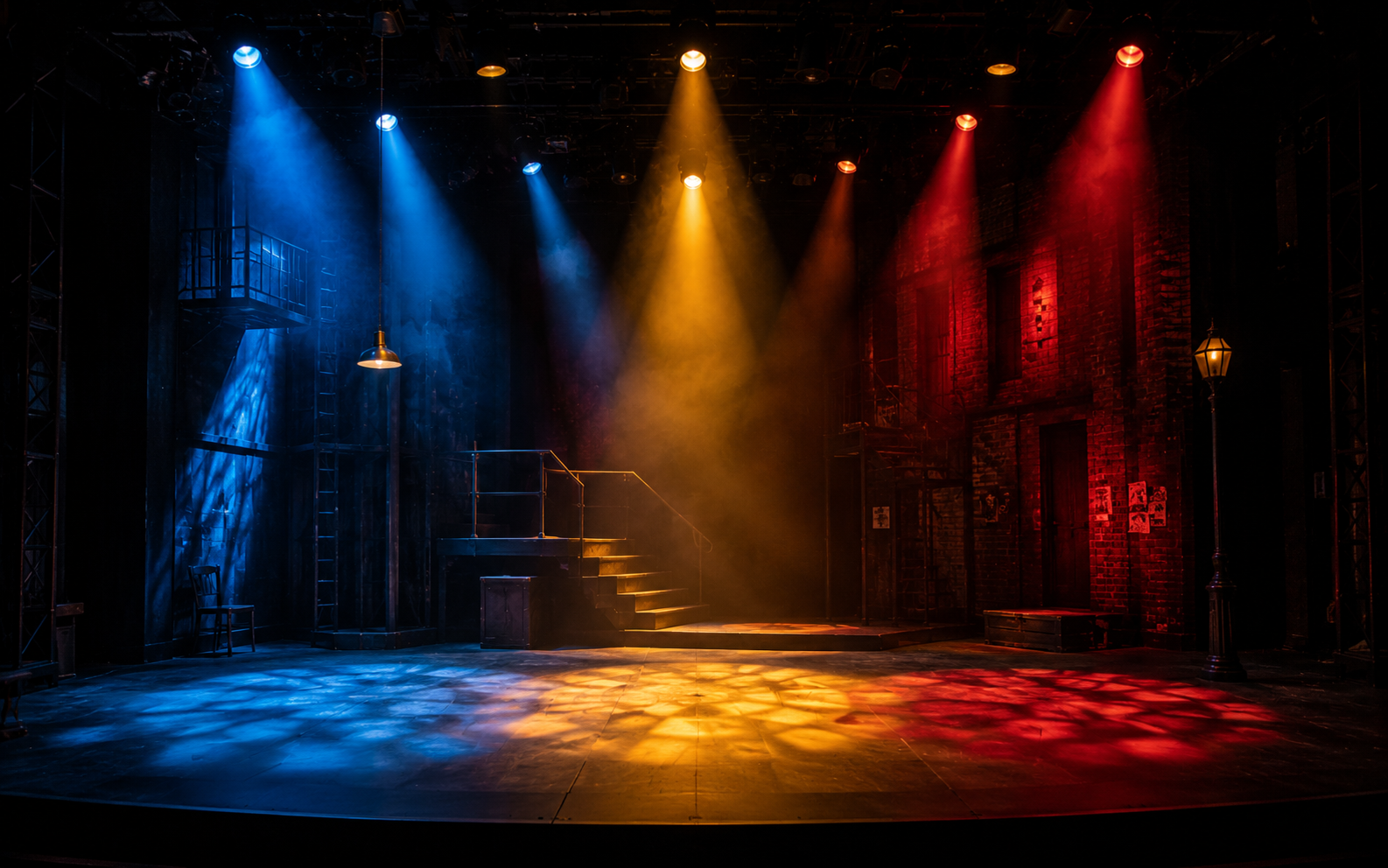
Every lighting designer works with a vocabulary of colour that audiences process subconsciously. Warm tones — ambers, golds, straw — create safety, domesticity, nostalgia. Cool tones — steels, blues, lavenders — suggest distance, unease, the passage into memory or dream. Red carries danger or desire. Green, used sparingly, can evoke the natural world or something slightly alien.
Modern LED technology has expanded this palette enormously. Where designers once worked with fixed gel colours that required physical changes between scenes, they can now transition through thousands of hues within a single cue. The creative possibilities have grown, but so has the temptation to over-design — to use every colour simply because it's available.
Shadow as Storytelling
The best lighting designers understand that what they don't illuminate matters as much as what they do. Shadow creates mystery, depth, and psychological complexity. A face half-lit carries more dramatic weight than one evenly washed in light. An actor stepping from darkness into a single pool of warm light enacts, physically, the journey from isolation to connection.
Peter Mumford, one of Britain's most celebrated lighting designers, has spoken about his approach as sculpting with light — revealing form through the careful placement of shadow rather than the elimination of darkness. It's a philosophy that requires restraint, which is perhaps why it's harder to master than the spectacle of a full rig firing at once.
The Collaborative Craft
Lighting design never exists in isolation. It responds to set, costume, direction, and — most critically — the emotional arc of the text. A good lighting designer reads the script as carefully as any actor, identifying the beats, shifts, and turning points that light can underscore or counterpoint. They attend rehearsals not to watch blocking but to understand rhythm, to feel where the energy rises and falls.
The best productions achieve a seamless integration where lighting, sound, set, and performance feel like a single coherent language. That integration is invisible to most audiences — which is exactly how it should be. The moment you notice the lighting as lighting, rather than feeling its effect, something has gone slightly wrong.